A sylph-like creature with a pink coiffure, bedecked in beads and crystals – the title character of Steven Arnold’s 1971 film Luminous Procuress – leads a pair of wide-eyed initiates on a vision quest. They encounter a carnivalesque human puppet show, diabolical priests, an orgy and the glitter-dusted, gender-busting performance troupe the Cockettes in their film debut. After screening at Cannes, it caught the eye of Salvador Dalí, who promptly took Arnold under his wing. Fitting, for the filmmaker and artist was sui generis, even among his fellow free-living and -loving Californians.
‘Steven was a born bohemian,’ says Vishnu Dass, director of the Steven Arnold archive and Heavenly Bodies, the 2019 documentary about his life. ‘Even by Bay Area standards, where he grew up, or in LA, where he lived for almost 20 years, he stood out as an uncompromising force. By 1960, at age 17, he was out and dressing in drag at a time when homosexuality was criminalised. Later, in an art scene known for minimalism and cool, he was an unapologetic mystic and surrealist maximalist.’
Elegant and lithe with a wild head of curls, Arnold liked to say he was creating his ‘own mythology from the shards of the universe’. When he relocated from San Francisco to LA in 1978, his mythology found its own Shangri-La: a cavernous former pretzel factory that he christened Zanzabar (after a papier-mâché clown head found at a flea market, painted with that name). Here, at his home and studio, Arnold hosted legendary salons, where, after cocktails, the work really began. With a team of collaborators, he built elaborate sets and conjured fantastical characters for his black-and-white tableau-vivant photography.
It’s tempting to compare Zanzabar to Andy Warhol’s Factory – if Warhol’s walls had been gold, not silver, and swathed in satin and velvet instead of tin foil. Both studios were hives of creativity and epicentres of queer culture that attracted movie stars and misfits alike. But where Warhol’s was a neutral space for art making, Zanzabar was itself a work of art. Arnold’s life was cut short by Aids in 1994, but this February, during Frieze Los Angeles, his legacy is coming to light in an exhibition at Del Vaz Projects, centred on an immersive reimagining of that very place.
In his unpublished autobiography, Arnold described moving ‘all my antiques in a huge rent-a-truck from San Francisco’ to a 5,000-square-foot building attached to a house. He painted his bedroom and library red, ‘inspired – of course – by Diana Vreeland’s famous New York apartment. My office I painted white; the kitchen was to be Tibetan, with orange and red cabinets and bright-blue cloud ceilings. I installed a make-up room, a prop room, and one huge wall to shoot my photos against.’
Simon Doonan, the author and former creative director of Barneys, was living in LA at the time, dressing windows at the high-end boutique Maxfield. He visited Zanzabar regularly. ‘It was an unlikely place for this kasbah Steven created,’ he says of its location on a bleak stretch of Beverly Boulevard. ‘That was part of the magic.’ Entering, Doonan recalls, ‘was almost like that bit in Popeye where Olive Oyl has a beach tent and Popeye follows her in, and it’s just this huge Versailles that keeps going and going’.
Arnold didn’t discriminate between antique finery and dime-store frippery, sacred or profane. He fashioned a bohemian paradise from junk-shop finds, religious relics, heirlooms, household items and his intricate, handmade shrines and totems, all held together with prodigious quantities of gold spray paint and glue. Occasionally, he asked to borrow props from Maxfield – a stuffed monkey being one of the more memorable. ‘I took it down to Zanzabar and Pandora was there,’ Doonan recounts, of Arnold’s best friend and muse. ‘She started wearing this taxidermied monkey on her head, which made her about 15 feet tall!’
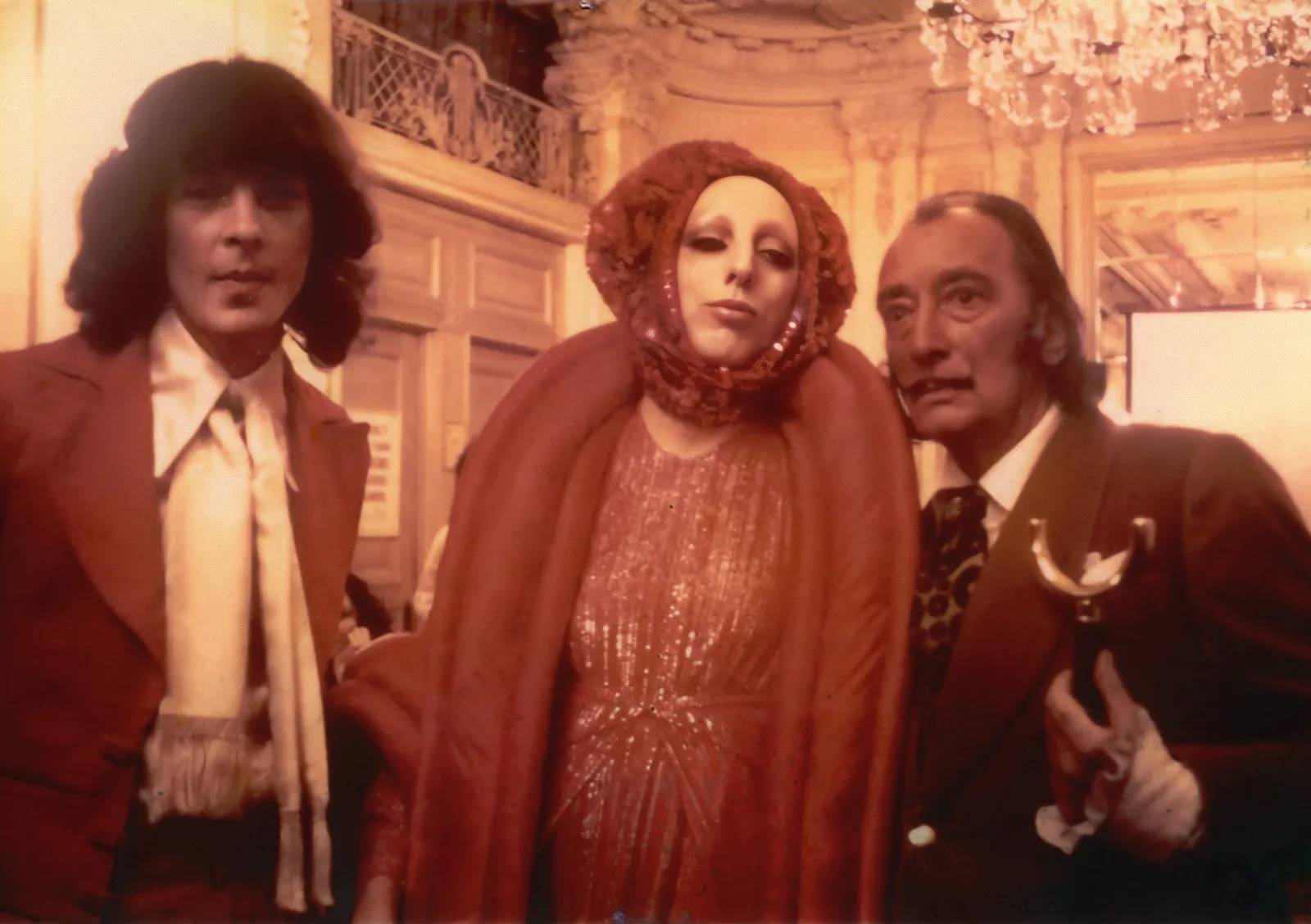
Arnold and Pandora connected in a high-school art class, whose teacher, Violet Chew, introduced them to Eastern religions, Beat culture and collecting. As teens, they spent hours in Arnold’s Oakland bedroom among its found icons and rare books. A decade later, Pandora starred in Luminous Procuress, which, in 1974, earned Arnold an invitation to assist with the opening of Dalí’s museum in Figueres, Spain. According to Dass, the most significant takeaway from his time with the artist was an understanding of ‘how you throw a party’.
Before social media, receiving a phone call about ‘a party at Steven’s’ was a boon, recalls the author Annie Kelly, who often visited Zanzabar with her husband, the photographer Tim Street-Porter. Other notable guests might include the psychologist Timothy Leary, Helmut Newton, the architect Buckminster Fuller, Warhol superstars Joe Dallesandro and Holly Woodlawn, art maven Joan Quinn or the Arquette clan. The fashion publicist and former style editor Anne Crawford arranged for Street-Porter to shoot Zanzabar for the now-defunct LA Style magazine. ‘I adored the fantasy of it,’ he says. (He would later also photograph the West Hollywood cottage where Arnold spent his final months.)
In 1985, Doonan started working for Diana Vreeland at the Costume Institute in New York. The Aids crisis was escalating, as Doonan recalls, ‘and Steven said to me: “You need to get out of LA. It seems like none of us are going to live that long.”’ Three years later, Arnold was diagnosed with HIV, and Zanzabar’s roof began to leak. Moving to a new home, with help from friends such as Vincent Jacquard, Ellen Burstyn and Stephanie Farago, who would establish the Steven Arnold Museum and Archives, was joyous. His notebooks reveal someone playful and enthusiastic, even when facing his own end. ‘Very Louis rosette bows in apple green,’ reads one note beside a sketch of an elaborate bed, while a plan for a ‘Balinese, baroque garden with French park overtones’ includes ‘chandeliers from the trees galore’. Ever the world builder, Arnold envisaged the pageantry of his death as a procession of angels and sculptures come to life.
Steven Arnold was a living example of personal liberation. This – and his boundless imagination – may prove to be his most lasting legacy. As Dass observes: ‘The world that queer people are working toward today – one that celebrates unfiltered creative expression, spiritual androgyny and non-binary consciousness – was already being realised within [his] walls.’
‘Steven Arnold: Cocktails in Heaven’ is at Del Vaz Projects, 259 19th St, Santa Monica, CA 90402 25 Feb–25 April 2026. For more information, ring 001 310 999 3060 or visit delvazprojects.org